The earliest memory I have of my grandfather dates back to 1984. My parents used to work late and so I would spend the day in my grandfather’s shop. It was a small, old place in the Vallecas neighbourhood, which has now been turned in to a furniture store. I was nine years old at the time, and as you can imagine at that age the mere thought of spending the summer cooped up in a shop made me break out into a rash. Be that as it may, I found the shop’s interior to be captivating. Wooden clocks of different shapes and colours, pendulums hanging from them, swinging endlessly, and metal appendages in the form of chains covering every millimetre of the walls, almost reaching the floor, formed a web of harmonious movements that hypnotised me. The sound of cuckoo clocks, whose punctual figures peeked out to greet each hour, which created a musical cacophony that still makes me feel nostalgic today. But most fascinating of all were the stories that my grandfather would tell me.
When there were no customers to attend to, Grandfather Antonio would sit down at his workbench, a small corner at the far end of the shop. He was used to spending hours alone, accompanied only by the radio, a table magnifying glass and many bewildering tools of ridiculous sizes. When he had no work to do, he escaped by solving a wrinkled word-search magazine that he never seemed to finish. When he closed the door there wasn’t a ray of light left, but he always wore a satisfied smile and a pocket watch that I never saw him part with.
‘It’s a watch full of class’, he would say to me solemnly every time he showed it to me and winked at me as he held it by the fob and spun it around.
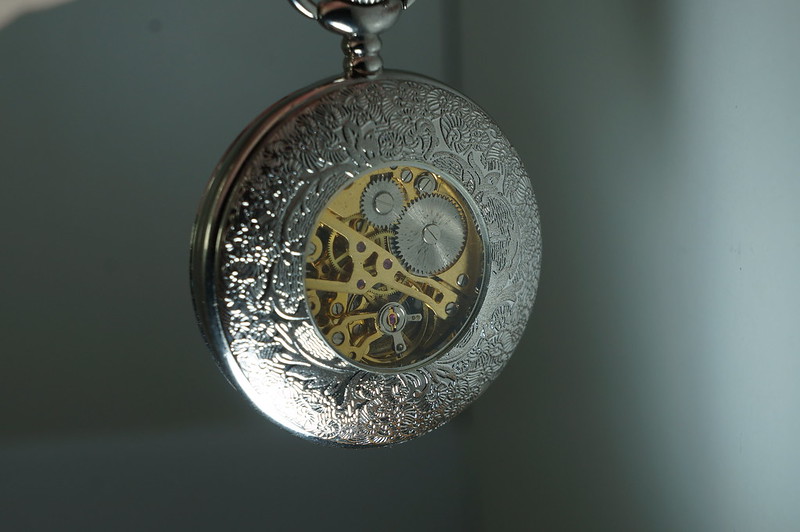
It was a beautiful golden watch. On the back, the engraving of a vine stood out and the initials could be read in the centre “M. L.” My grandfather never let anybody touch it, not even me. And whenever someone asked about the initials, he would hastily put the watch away and shrug his shoulders. On more than one occasion when he didn’t know I was watching I could see him caress it and spend time holding it in his hands. Those were the times when the wrinkles on his face deepened and he had to silence a cry of nostalgia.
My grandfather travelled to Madrid from a small town in the south of Spain. He came from a well-off family, owners of a small piece of land which allowed them to live comfortably, even though it was not enough to be able to consider themselves as rich. They worked on the land themselves and were able to hire additional workers. His older brother was, according to what he told me, a restless person with interests that didn’t align with the family’s traditions: he wanted to travel and see the world, which generated an important conflict in the family, especially with his father, my great-grandfather. A strict man with a sour and aggressive character, he shot down this conflict with two quick hand movements and a leather belt, achieving the exact opposite of what he intended.
My grandfather’s brother ran away two days later with just a few coins in his pocket, his body still bruised. Several years later, my grandfather received news that his brother was still alive in the form of a box that he had received for his birthday. More packages followed the first and occasionally they came with a photograph. My grandfather treasured these black and white, grainy, and sometimes blurry photographs. The last package he received was in 1935, just before the Civil War crept into the lungs of society and spread like a contagious, aggressive virus. In the box he found a small, dented watch and a photograph of his brother posing outside a shop in Madrid.
The war swept through their lands like a typhoon, and just two years later Grandfather Antonio fled to Madrid, fearing for his life, leaving everything behind. His parents were killed in the conflicts. Collateral damage, one might think, but the truth is that they were stripped of their land with impunity using the war as an excuse. My grandfather was eighteen years old then and he survived thanks to an old childhood friend who hid him and took him into his home.
Once he had arrived in Madrid, he set out to find his brother and thanks to the photograph, he managed to find the shop where they happily reunited. He stayed there and lived with him and learned the watchmaker’s trade. He got married in 1939 and that very same year he had an adorable son, my father. They were happy for four years, until the winter of 1943, when the influenza claimed the life of his brother first, and then his wife just a month later. He found himself alone overnight, having to take care of a four-year-old boy and without the slightest idea how to do so.
In losing his wife, he also lost the will to live. He took refuge in his work and when his son wasn’t at school, the neighbours took care of him. They had six children and were good souls, who felt sorry for the boy. He would drink until he passed out in his chair, he stopped shaving regularly and he would even forget to eat occasionally.
Until he met the women with the watch.
That summer, the summer of 1984, he told me his most fascinating story yet. The watch had belonged to a woman who, in 1944, had burst into the shop like a hurricane. It was late and my grandfather was about to leave when he heard a noise outside and then someone knocked at the door. The woman at the door was stifling, breathing heavily as if she had been running. She seemed scared. She was wearing a beautiful black and white printed silk dress with a huge bow on the front. Her hands were in with elegant white threaded gloves. Her hair was tied back and covered by a large sun hat. She took something out of her black leather bag and gently handed it to my grandfather.
‘Please,’ begged the woman with a subtle French accent. ‘Please let me in! I need to fix it; the glass is broken, and it doesn’t work.’
My grandfather was captivated by the woman’s intensity and nodded, unable to escape her gaze. Then he looked at the watch and turned it over in his hands, gazing at it with an almost reverential attitude.
‘I was about to leave, but I’ll take a look at it. Give me a second.’
He locked the padlock on the door, turned the small rectangular sign hanging on the glass to ‘closed’ and went to the small workshop, asking the woman to follow him.
‘Please take a seat,’ he said pointing to a chair, ‘it will only take a moment’.
He sat for about an hour as he carefully dismantled the complex mechanism piece by piece. When he took his eyes off the clock, he was startled to find the woman beside him, standing motionless, as if she were an apparition, silently observing his work. He cleared his throat and said:
‘Your watch took a big hit; I need to change the glass but a number of pieces too. It’s a very high-quality watch and it’s very rare. A Breguet if I’m not mistaken. May I ask where you bought it?’
‘I don’t remember,’ she said with a shrug of her shoulders, as if to try and play it down. ‘Will you be able to repair it?’
‘Of course, I will be able to,’ he said, somewhat offended, ‘but it will take time and it won’t be cheap.’
‘I’m counting on you,’ she said, and handed over a sum of money that was more than my grandfather expected the repairs to cost.
‘Oh.’ My grandfather responded raising his hands, refusing to accept it. ‘It won’t be that much,’
She took his hands gently and placed the money in his palm.
‘This money isn’t just for repairing the watch, it’s for your kindness and discretion,’ she said. ‘I will come back within two weeks to check your progress.’
My grandfather got to work immediately. It took a lot longer than two weeks to make it new again. The woman came back to the workshop every week. At first, she seemed frustrated by the delay, but later fascinated to see the delicate work that my grandfather was doing. Many of the pieces he replaced were originals, exclusive and expensive. All of which were of foreign origin, which was hard to come by in Spain at the time. Spain was watched with suspicion by its current European allies in case it took sides in the war.
At first the woman stood by and watched the delicate process, letting the time pass, and gradually, almost without realising it, that time increased.
It was in these moments that my grandfather felt strangely happy. He would get nervous and eager when the day of her visits came around and he would make coffee and pastries to entertain his visitor. He used to get irritated when another customer would interrupt those moments. Sometimes it was several days before any customers came in, but during the woman’s visits it seemed that there was always someone waiting, and Grandfather Antonio felt annoyed and jealous when he heard them talking. The conversations were so insubstantial, so banal, that he felt like grabbing the customers by the lapel and kicking them out of his shop.
When they were alone together, she told him about the latest news from France, how her country had been invaded and the fear of losing her family that were trapped there. My grandfather always offered messages of optimism.
‘The Germans won’t be in your country for very long,’ and then he would throw himself into the arms of nostalgia and reminisce about the fields and crops in the south. He also told her stories about things that happened in Madrid and, of course, he would talk about watches.
After five months, the watch was finally fixed. That day my grandfather couldn’t concentrate on anything else, proud of his work, the achievement of a humble watchmaker in Madrid. But on the other hand, when the women came to collect the watch, she would disappear from his life, and he was certain that he would never hear from her again. Contradictory feelings of euphoria and pessimism poisoned his mood.
She never appeared that day. Nor the next day. Nor ever again. After a week, a boy came into the shop.
‘Are you Antonio, the watchmaker?’ the young boy asked.
‘The very same.’
‘This letter is for you.’
‘A letter? For me?’ He asked while the boy nodded. ‘Who gave it to you?’
‘A French woman,’ said the boy with a smile as large as his face. ‘She gave me a good tip.’
My grandfather ripped open the sealed envelope and read the letter carefully.
The woman was leaving Madrid and would meet him at four o’clock in the afternoon at the Estación del Norte. My grandfather looked around. All the clocks showed the same time. It was just twenty minutes to four. He grabbed his hat and the Breguet and closed the door without wasting time locking the metal padlock. He tried to find a taxi to take him to the station. He ran with his watch in his hand to the platform where a score of women, men and children were bidding farewell to their loved ones as the train began its slow journey. For months my grandfather held out hope that the woman would return. The next day he would walk through the door, greet us with his funny French accent and maybe stay forever.
It never happened.
He never saw her again.
My grandfather died at 78 years old, but before he died, he made it clear to his whole family, both in will and in word, that they should bury him with his watch.
‘Whatever I find on the other side I must have my watch close by, I’ll need to know the time and show the best work of my life to everyone I meet,’ he then ducked his head and added, ‘and who knows if…?’
But his death isn’t the end of this story.
A few months later I received an enormous box. The executor of my grandfather’s will, who had been given very strict instructions, had sent it to me. The box contained a number of watches, well cared for, wrapped in suede cloths of different colours and protected in velvety boxes. His private collection. There was also a photo album and a file of newspaper clippings.
The album contained all the black and white photographs he had received from his brother, which he had kept until his death. Then there were others in which my grandfather was posing with his brother and my grandmother. I didn’t remember seeing my grandmother before. She was a beautiful woman. I also found another photo of my grandparents cradling my new-born father in their arms.
When I opened the folder, I found something even more surprising, something that my grandfather had kept inside for so many years. It was French newspaper clippings. I was stunned to see the printed photo of an extremely beautiful woman and written in headlines that read: ‘M. L. spy and heroin of the revolution.’ At that moment, from among the clippings, a piece of paper slid to the floor. It was a handwritten letter and it said:
My dear Antonio,
I was forced to return to France, and I am sorry that I never got the opportunity to say goodbye. What a tragic irony to discover that the watchmaker was late. But maybe it was for the best, our goodbye would have been like a stake through the heart. I don’t think I can return to Spain and see you again, because I’m convinced that if I did, I wouldn’t be able to leave you again. Neither my family nor my husband would understand. I hope and I wish with my entire being that you can forgive me someday.
I hope you keep my watch and that it serves as a reminder of all the times we spent together. I never told you this, but the day that we met, the day that I came into your shop, I was in great danger and thanks to God I was able to survive, so any debt that I owe you can never be repaid. Keep it. Maybe one day you can return it to me in this life or another.
Yours always.
M.L.
Alberto López Rosa (Madrid, 1975) is a technical engineer (MBA) working in the Health industries. He’s recently done some Creative Writing courses at Cursiva, Penguin Random House’s writing academy and is also a student at Phantastica, the writing school of SFF and horror. He is also working on his first horror novel with fantastical elements which he hopes to publish sometime soon.
Jack Caine is a twenty-something freelance translator from the Lake District, England who translates documents from Spanish, German and Italian into English on topics such as literature, other cultures, travelling and more.
Jasmin Griffiths is a Plymouth University graduate with a BA in English Literature and Creative Writing. She grew up in the south of Spain and after moving back to England decided to pursue her passion of writing. She has performed music and her poetry all over the country and also enjoys writing creative nonfiction and short stories.
This short story is part of a research project on speculative historical fiction in Ireland and Spain funded by the AHRC and the University of Plymouth.
Picture credits: Christophe Lesimple

 THE WANDERING BARD